Why Mesothelioma Can Be Hard to Recognize Clinically
Clinical mesothelioma questions usually sit between first suspicion and a confirmed plan. Tests, procedures, and staging labels can each answer different parts of the puzzle, but they do not all serve the same purpose. The section below walks through Why Mesothelioma Can Be Hard to Recognize Clinically.
Most of the source material here comes from older clinical practice, when imaging, pathology, staging systems, and symptom-control options were less refined than they are now. That older literature is still useful for understanding the logic behind workup and care decisions, but it cannot replace case-specific advice from an experienced mesothelioma team.
Clinical context: Why Mesothelioma Can Be Hard to Recognize Clinically
Why Mesothelioma Can Be Hard to Recognize Clinically makes more sense when it is placed inside the broader mesothelioma story of early symptoms and clinical recognition, staging and prognosis, and supportive care and biopsy-track questions. Readers rarely face one issue in isolation, so a focused page works best when it also shows how the topic connects to diagnosis, treatment, research, or exposure history.
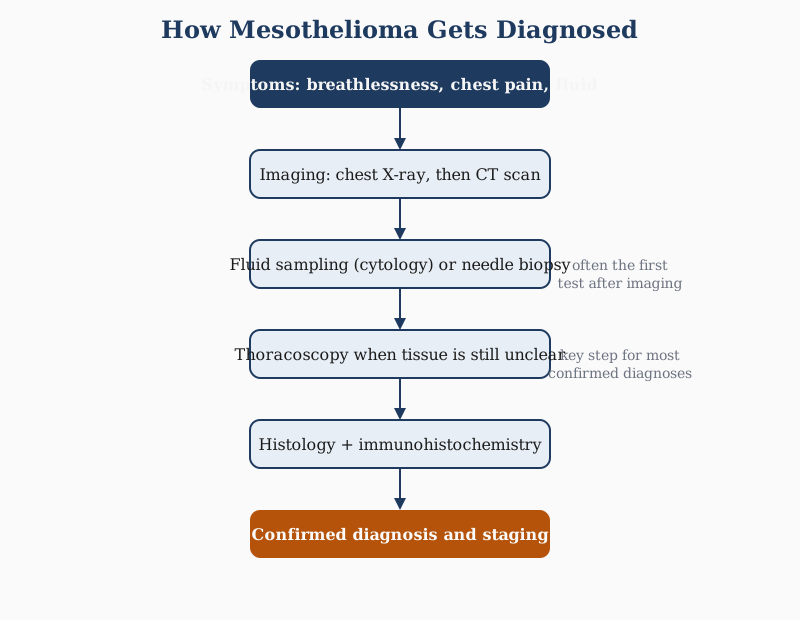
In the clinical material, the discussion keeps circling back to sequence. Symptoms lead to imaging, imaging leads to sampling, sampling leads to pathology, pathology leads to staging, and staging then reshapes treatment or supportive-care planning. That chain is what makes the section still useful.
The points below are worth reading with that frame in mind. They show where the topic becomes most concrete: not in generic reassurance, but in the practical details that change the next diagnostic, treatment, research, or legal decision.
Key clinical points: Why Mesothelioma Can Be Hard to Recognize Clinically
- Several forces conspire here. By the time symptoms appear, the tumour has usually spread extensively through the pleural or peritoneal lining and behaves clinically like a cancer that has spread from somewhere else. Confirmation rests on cell or tissue appearance, which pathologists can struggle to separate both from benign reactive pleural change and from secondary cancers, adenocarcinoma above all. The doubt once went deeper still: for decades, leading pathologists refused to accept that the tumour existed at all. And no blood or effusion marker uniquely identifies mesothelioma or tracks its course. The long-running diagnostic controversy is recounted in Eur Respir Rev, and current biomarker limits in Cancers.
- On examination, malignant pleural mesothelioma typically announces itself as an effusion or a mass: the chest wall moves less on the affected side, percussion over the fluid gives a stony-dull note, and breath sounds are quieter or absent altogether. These overlap with the common symptom profile of the disease (NCI).
- When the tumour invades nearby structures, symptoms follow: obstruction of the superior vena cava, spinal cord compression, Horner’s syndrome, pressure on the oesophagus, chest wall masses, or malignant disease around the pericardium. Definitive diagnosis still requires tissue confirmation through the structured pathway described in current guidelines (SEOM guidelines).
- A mass on its own dulls the percussion note and softens the breath sounds; now and then, and with no effusion present, breath sounds instead turn harsh, almost bronchial in quality.
Using this in care discussions: Why Mesothelioma Can Be Hard to Recognize Clinically
The most useful modern reading habit here is to keep purpose and next step separate. A test may be for diagnosis rather than prognosis, a procedure may be for symptom relief rather than cure, and a staging label may clarify options without settling them.
For patients and families, the practical value of this topic is understanding what a procedure, finding, or treatment may clarify and where its limits are. Individual decisions still depend on tumour type, stage, symptoms, overall health, and review by an experienced medical team. Readers who want the broader site overview first should start with Mesothelioma Diagnosis, Pathology, and Imaging, then return to this page for the narrower background. That sequence usually makes the older material easier to use well.
Where specialist judgment still matters: Why Mesothelioma Can Be Hard to Recognize Clinically
Clinical decision-making in mesothelioma almost always depends on sequence, sampling quality, stage, symptoms, and specialist review. That is why older procedural or pathology writing can still be helpful even when present-day practice has moved on in important ways.
Keeping a focused page on why mesothelioma can be hard to recognize clinically gives readers a steadier explanation of the issue without forcing them to piece it together from denser medical writing on their own.
How to use this in care decisions: Why Mesothelioma Can Be Hard to Recognize Clinically
- Ask how this issue applies to your mesothelioma type, stage, symptoms, and overall health.
- Weigh the likely benefits, limits, and risks in your own case instead of treating general information as a personal recommendation.
- Use a specialist centre when the decision is complex or could change surgery, treatment, or pathology planning.
Related reading
- Understanding the Diagnostic Pathway for Suspected Mesothelioma
- Understanding Mesothelioma Staging and Prognosis: What Your Diagnosis Means
- Mesothelioma Diagnosis, Pathology, and Imaging
- Mesothelioma Resources & Support
More clinical background: Why Mesothelioma Can Be Hard to Recognize Clinically
Read as background, why mesothelioma can be hard to recognize clinically works best when it is kept connected to early symptoms and clinical recognition and staging and prognosis. That connection helps readers understand not just the facts on the page, but why this issue changes diagnosis, treatment thinking, research direction, or legal interpretation.
A second reason to keep a focused page like this is that mesothelioma questions rarely arrive one at a time. People move from exposure history to symptoms, from symptoms to imaging, from imaging to biopsy, and from biopsy to treatment or support planning. A narrower article makes one part of that chain easier to absorb without losing the larger picture.
Clinical pages are often where readers feel the most pressure, because these are the topics that show up before biopsy results, during staging discussions, or while families are trying to understand why one procedure is being offered instead of another. Clear framing reduces the chance that a technical term will be mistaken for a complete answer.
That is especially important in mesothelioma, where the same person may hear about fluid drainage, thoracoscopy, pathology, stage, surgery, radiotherapy, systemic therapy, and symptom control within a very short time. A focused article helps slow that sequence down without pretending that one page can replace specialist judgment.
Bottom line
The main takeaway is that this section can clarify an important part of mesothelioma care, but interpretation still depends on tumour type, stage, symptoms, overall health, and specialist review.
Medical and legal caution
This article is for education only. It is not personal medical advice, and it does not predict treatment results, legal eligibility, compensation, or case value.
References
- European Respiratory Review — Malignant pleural mesothelioma: history, controversy and future of a manmade epidemic: the history of diagnostic doubt and confusion with secondary cancers.
- Cancers — Circulating Biomarkers and Targeted Therapy in Pleural Mesothelioma: why no serum or effusion marker identifies the disease on its own.
- National Cancer Institute — Mesothelioma Symptoms and Signs: the clinical picture that physical signs overlap with.
- Clinical and Translational Oncology — SEOM clinical guidelines on malignant pleural mesothelioma management (2020): the tissue-confirmation standard that resolves uncertain cases.