Mesothelioma Epidemiology: The Basics
Exposure history is central to mesothelioma because the disease usually emerges long after the relevant contact with asbestos took place (NCI). Older epidemiology does not replace individual review, but it can show how risk was measured, debated, and sometimes undercounted. The section below walks through Mesothelioma Epidemiology: The Basics.
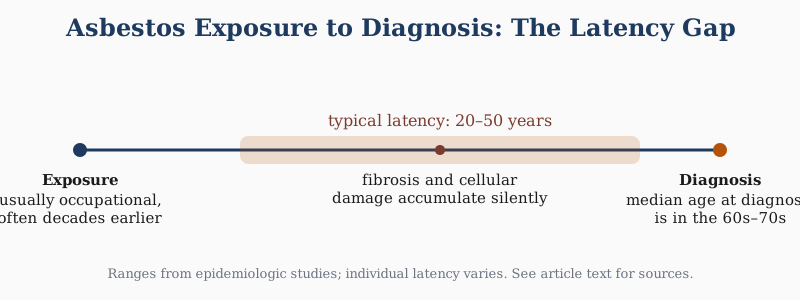
The evidence is mainly historical: cohort follow-up, registry counts, factory or mining records, and environmental observations collected with uneven methods. Read that material as context for how asbestos risk was recognised and argued about, while keeping in mind that individual medical and legal questions still depend on a much more specific exposure history.
Exposure context: Mesothelioma Epidemiology: The Basics
Mesothelioma Epidemiology: The Basics makes more sense when it is placed inside the broader mesothelioma story of how cases are counted, what aetiology means beyond simple exposure tallies, and familial clusters and prevention questions. Readers rarely face one issue in isolation, so a focused page works best when it also shows how the topic connects to diagnosis, treatment, research, or exposure history.
In historical mesothelioma writing, the point is usually not a single dramatic conclusion. It is the accumulation of evidence: where asbestos was used, who was counted, which populations were missed, and how patterns looked different once investigators compared occupations, regions, and time periods.
The points below are worth reading with that frame in mind. They show where the topic becomes most concrete: not in generic reassurance, but in the practical details that change the next diagnostic, treatment, research, or legal decision.
Key exposure and risk points: Mesothelioma Epidemiology: The Basics
- Few exposure–disease links run as tight as the one between asbestos, in each of its forms, and malignant mesothelioma (called simply mesothelioma from here on). So tight, in fact, that studying mesothelioma’s epidemiology is nearly the same thing as studying the epidemiology of asbestos exposure itself: cataloguing who was exposed, to which fibre type, under what circumstances and at what times, and what became of them afterwards (Eur Respir Rev).
- On the descriptive side: worldwide figures. Patients with mesothelioma rarely live long, yet death statistics for the disease generally fall short of incidence figures — most likely because the disease is hard to diagnose and because death certificates, as a class of document, have well-known shortcomings.
- Where a population’s asbestos exposure is well documented and follow-up has run long enough, the spread of latency intervals — exposure to onset — looks much the same across studies. Survival, though, runs somewhat shorter when the disease takes the peritoneal form: around 6 months on average, against 9 months otherwise. For the modern consensus latency range, see NCI.
- One root of that scepticism was Willis’s influential pronouncement that no such entity existed. Primary tumours of the coelomic membranes could not be ruled out in principle, he conceded, but nearly all reported cases were, in his view, surely just serosal disease that had spread from an undiscovered primary tumour in a nearby organ.
Using this history today: Mesothelioma Epidemiology: The Basics
Readers usually benefit most from treating older incidence and exposure material as context. It can make a work history, a town history, or a family exposure story easier to understand without pretending that past registry data are the final word on any one person’s risk.
For patients and families, sections like this help explain why mesothelioma patterns differ across countries, jobs, and time periods. They are especially useful when someone is trying to make sense of old exposure history that may have happened decades before symptoms appeared. Readers who want the broader site overview first should start with Mesothelioma Exposure and Epidemiology, then return to this page for the narrower background. That sequence usually makes the older material easier to use well.
Where exposure evidence still needs interpretation: Mesothelioma Epidemiology: The Basics
Historical mesothelioma writing still matters because so many people are reconstructing exposure after the fact. Old employers close, records disappear, and families are left with job titles, addresses, military service, or fragments of building history rather than a neat paper trail.
That is one reason to keep a page like mesothelioma epidemiology: the basics in the collection. It helps readers place those fragments inside the longer story of asbestos use, recognition, and undercounting that runs across mesothelioma history.
What to do with this exposure history: Mesothelioma Epidemiology: The Basics
- Compare this exposure history with your own work, home, or community exposure story.
- Write down the timing, place, duration, and likely materials involved while you still remember them.
- Take that timeline to a doctor or specialist centre if symptoms, concern, or possible asbestos contact needs review.
Related reading
- Aetiology of Mesothelioma Beyond Simple Exposure Counts
- Familial Clusters, Prevention Research, and Epidemiology Questions
- Mesothelioma Exposure and Epidemiology
- Occupational vs Environmental Asbestos Exposure: Understanding Your Risk and Rights
- Mesothelioma Resources & Support
More exposure background: Mesothelioma Epidemiology: The Basics
Read as background, mesothelioma epidemiology: the basics works best when it is kept connected to how cases are counted and what aetiology means beyond simple exposure tallies. That connection helps readers understand not just the facts on the page, but why this issue changes diagnosis, treatment thinking, research direction, or legal interpretation.
A second reason to keep a focused page like this is that mesothelioma questions rarely arrive one at a time. People move from exposure history to symptoms, from symptoms to imaging, from imaging to biopsy, and from biopsy to treatment or support planning. A narrower article makes one part of that chain easier to absorb without losing the larger picture.
Historical background is also useful because it shows how undercounting happens. Workers may have incomplete job records, communities may not recognise environmental exposure until years later (WHO), and registry systems often improve only after a problem is already large — a pattern documented in detail for South Africa’s asbestos regions (Am J Public Health). That background helps readers interpret why official numbers sometimes look lower than the lived reality.
This is one reason older epidemiology is important background, but it cannot settle any one person’s medical or legal situation by itself. Older epidemiology may not answer a case-specific question, but it can explain how the wider pattern emerged and why certain occupations, regions, or family histories keep appearing in mesothelioma conversations.
Bottom line
The main takeaway is that mesothelioma patterns usually reflect where and how asbestos was used over time, but older population trends do not replace an individual review of symptoms, exposure history, and current medical evidence.
Medical and legal caution
This article is for education only. It is not personal medical advice, and it does not predict treatment results, legal eligibility, compensation, or case value.
References
- National Cancer Institute — Asbestos Exposure and Cancer Risk: the asbestos–mesothelioma link and the 20–50 year latent period that anchors exposure-based epidemiology.
- European Respiratory Review — Malignant pleural mesothelioma: history, controversy and future of a manmade epidemic: how mesothelioma epidemiology tracks the history of asbestos exposure.
- American Journal of Public Health — Asbestos-related disease in South Africa: the social production of an invisible epidemic: how asbestos disease went under-recognised and under-recorded in exposed communities.
- World Health Organization — Asbestos: elimination of asbestos-related diseases: the global picture of exposure routes, environmental risk, and prevention.