Mesothelioma Claims After Death: Rights of Families and Estates
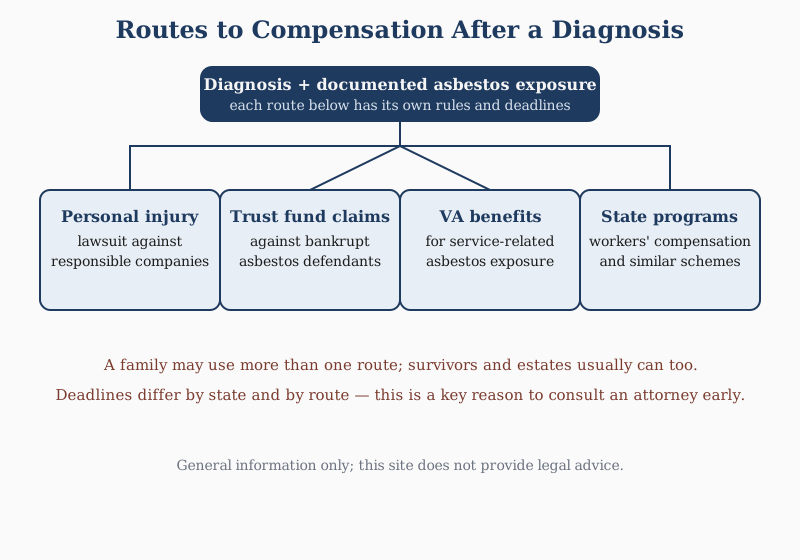
When a person dies of mesothelioma, the legal options tied to their asbestos exposure do not usually die with them. In broad terms, three tracks can survive: claims by the family or estate against the companies responsible for the exposure, claims against the bankruptcy trusts that asbestos companies were required to fund, and — for veterans whose disease was linked to service — federal survivor benefits through the VA. What families often underestimate is timing: the deadlines that govern these claims are set by state law or by each program’s rules, and they are generally measured in years, not decades.
This article is general information, not legal advice. Rules differ by state and by program, and only a licensed attorney or a VA-accredited representative can tell you what applies to your family.
What Survives the Patient
Four distinct tracks are usually worth asking about after a death from mesothelioma:
- Wrongful death claims are brought against the companies that exposed the person to asbestos. They seek compensation for what the death cost the family: lost financial support, funeral expenses, and the loss of the person’s companionship.
- Survival (estate) claims continue claims the person held or could have brought while alive — for their own pain, medical costs, and lost income — and are pursued by the estate’s representative for the benefit of the estate and heirs.
- Asbestos trust fund claims run against trusts that asbestos companies were required to establish as a condition of bankruptcy protection. That mechanism comes from a specific provision of the federal bankruptcy code (11 U.S.C. § 524(g)), and the trusts exist precisely so that people diagnosed decades later — and their survivors — can still be paid. A death does not erase trust eligibility in most cases, but each trust writes its own rules.
- VA survivor benefits apply when the veteran’s mesothelioma was connected to military service. Dependency and Indemnity Compensation (DIC) is a tax-free monthly payment for eligible surviving spouses and dependent children (VA).
Our broader legal and compensation guide maps these routes for living patients; the same map applies after a death, with different deadlines and different people holding the rights.
Who Can File
The exact answer depends on state law. As a general pattern: the estate’s court-appointed representative brings estate and trust claims; wrongful death rights belong to a defined circle of family members — almost always including the surviving spouse and children, often parents, and sometimes others who depended on the person financially. Some states route everything through the estate; others allow named relatives to sue directly. None of this is uniform, which is why an attorney licensed in your state is the only reliable source for who may file in your case.
Why Deadlines Make This Urgent
Two clocks matter. First, state deadlines for wrongful death and survival claims typically start running at the date of death — or, in some states, from the date the family connects the disease to asbestos exposure — and they commonly allow only a few years. Second, the VA does not set a single filing deadline for DIC, but when you file can affect how far back payments reach, so timing still matters (VA).
Families who lose options usually lose them by waiting — through grief, through the work of settling an estate, or simply because no one said the deadlines existed. Asking early costs nothing; consultations with mesothelioma attorneys are typically free, and VA-accredited representatives help with benefits claims at no charge.
Working With an Attorney After a Death
Attorneys who handle these cases begin with documents, and the family usually holds most of them:
- Death certificate and the pathology report confirming mesothelioma — the single most important medical document, since mesothelioma is frequently confused with other cancers until tissue is examined
- Medical records and treatment history
- A work history: employers, job sites, trades, and decades, however approximate
- Military records (DD-214 and duty assignments) if the person served
- Names of co-workers who can describe working conditions
The legal background behind these claims — how courts treat asbestos causation and exposure proof — is covered in our asbestos legal background hub, and our legal resources page explains how consultations and contingency arrangements generally work.
When Grief and Paperwork Collide
The weeks after a death are the wrong time to make decisions and the right time to know what exists. Practical guidance for the final months, including the paperwork worth doing early while the patient can still participate, is in what to expect at the end of life. And the person holding the family together in this period — often already doing the caregiving, the calls, and the forms — should not do it unsupported: the caregiver’s guide includes the supports that remain available to families after a loss.
References
- U.S. Department of Veterans Affairs — Dependency and Indemnity Compensation: the tax-free survivor benefit for eligible spouses and children of veterans whose death relates to service.
- Office of the Law Revision Counsel / govinfo — 11 U.S.C. § 524(g): the federal bankruptcy provision under which asbestos trusts were created to pay present and future claims.
- National Cancer Institute — Asbestos Exposure and Cancer Risk: asbestos exposure causes most mesotheliomas.
- U.S. Department of Veterans Affairs — Asbestos exposure eligibility: VA recognition of asbestos-related diseases, including mesothelioma, and the occupations where exposure occurred.
This article is general information, not legal advice. Deadlines, standing, and procedures vary by state and program. Consult a qualified attorney or a VA-accredited representative about your specific situation.