Mesothelioma Treatment Options: A Complete Guide
A mesothelioma diagnosis leaves most people asking whether anything can actually be done, and the answer is that several treatments are in regular use. This page lays them out: surgery such as pleurectomy/decortication and extrapleural pneumonectomy for selected early-stage disease, the standard pemetrexed plus cisplatin chemotherapy with a median survival of 12.1 months, radiation for local control and pain, and the FDA-approved immunotherapy pair nivolumab plus ipilimumab, which reported a median overall survival of 18.1 months. It also covers what happens when cure is not the goal, including fluid drainage, pleurodesis, pain control, and supportive care that runs alongside disease-directed treatment. Treatments are usually combined rather than given singly, and the right mix depends on stage, cell type, tumor location, and your own goals.
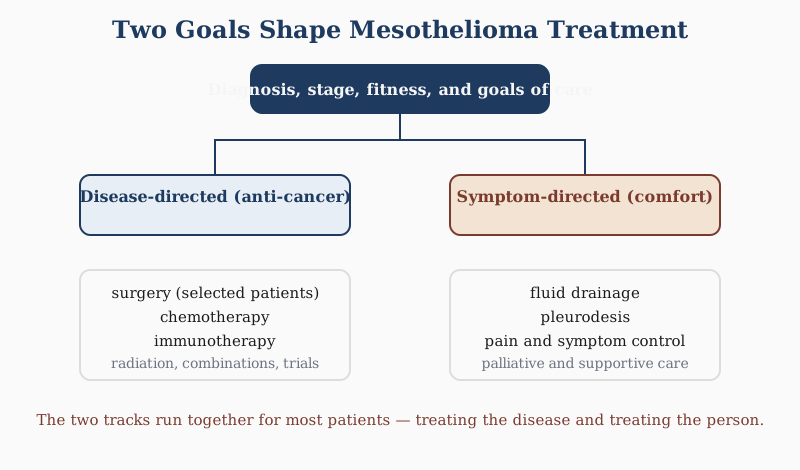
Understanding Multimodal Treatment Approaches
Modern mesothelioma treatment typically involves a multimodal approach—combining multiple therapies to achieve better outcomes than any single treatment could provide. The specific combination depends on several factors:
- Stage of disease at diagnosis
- Cell type (epithelioid, sarcomatoid, or biphasic)
- Location of the tumor (pleural, peritoneal, or pericardial)
- Overall health and performance status
- Patient preferences and treatment goals
Surgical Treatment Options
Surgery plays a crucial role in mesothelioma treatment, either as a curative attempt in early-stage disease or for palliative symptom relief in advanced cases (NCI).
Extrapleural Pneumonectomy (EPP)
Extrapleural pneumonectomy is an aggressive surgical procedure that removes:
- The entire affected lung
- The pleural lining (both parietal and visceral pleura)
- The hemidiaphragm
- The pericardium
Best candidates for EPP:
- Early-stage disease (T1-T2)
- Epithelioid cell type
- Good overall health and lung function
- No significant cardiac disease
- Tumor confined to one hemithorax
Outcomes: Studies show median survival of 12-19 months for EPP alone, but when combined with chemotherapy and radiation, some patients achieve 2-year survival rates of 35-40%. Patients with epithelial histology and complete tumor removal have the best prognosis.
Pleurectomy/Decortication (P/D)
Pleurectomy/decortication is a lung-sparing surgery that removes:
- The pleural lining
- Visible tumor tissue
- Sometimes the diaphragm or pericardium
Advantages over EPP:
- Preserves lung function
- Lower operative mortality (typically 1-4% vs. 5-10% for EPP)
- Shorter recovery time
- Better quality of life post-surgery
When P/D is preferred: Research increasingly shows that P/D combined with adjuvant therapies produces survival outcomes similar to EPP, while preserving lung function and reducing complications. Many centers now favor P/D as the primary surgical approach (J Clin Med meta-analysis; Transl Lung Cancer Res).
Older cytoreductive protocols also tested intrapleural cisplatin and mitomycin after pleurectomy/decortication, with small series reporting median survival around 17 months. If gross tumor cannot be removed without pneumonectomy, surgeons may consider escalating to EPP only in carefully selected patients because pulmonary resection introduces additional risks such as bronchial stump dehiscence and post-pneumonectomy ARDS.
Palliative Surgical Procedures
Pleurodesis:
- Controls recurrent pleural effusions
- Performed via thoracoscopy
- Uses talc or chemical agents to seal the pleural space
- Provides significant symptom relief
Thoracentesis:
- Drains pleural fluid buildup
- Temporary relief measure
- Can be repeated as needed
- Improves breathing and reduces chest pain
Radiation Therapy
Radiation therapy uses high-energy beams to destroy cancer cells and is used in several ways for mesothelioma treatment (World J Clin Oncol).
Adjuvant Radiation After Surgery
Post-EPP Radiation: The combination of EPP with postoperative radiation (4500-5500 cGy) has shown improved local control. The Memorial Sloan-Kettering series reported median survival of 12.6 months with 2-year survival of 35% for patients receiving EPP plus radiation.
Post-P/D Radiation: After pleurectomy/decortication, radiation doses of 4000-5000 cGy to the hemithorax can reduce local recurrence rates.
Intensity-Modulated Radiation Therapy (IMRT)
IMRT allows precise targeting of tumor tissue while sparing healthy organs:
- Reduces radiation damage to the remaining lung
- Minimizes cardiac toxicity
- Enables higher, more effective doses to tumor beds
- Particularly valuable after lung-sparing surgery
That shift toward more conformal treatment reflects an important historical lesson: whole-lung external beam radiation at safe conventional doses generally did not control diffuse pleural mesothelioma well, so modern radiation is used more selectively for adjuvant local control or symptom relief.
Internal radiation techniques such as brachytherapy are much less common in mesothelioma than external-beam approaches, but they may be considered in select, highly localized situations at specialized centers.
Palliative Radiation
Lower-dose radiation (20-30 Gy) effectively treats:
- Chest wall pain
- Tumor masses causing obstruction
- Painful bone metastases
- Procedure tract sites to prevent seeding
Chemotherapy Options
Chemotherapy remains the most widely used systemic treatment for mesothelioma, though the disease is notoriously chemotherapy-resistant.
First-Line Chemotherapy Regimens
Pemetrexed + Cisplatin (Standard of Care): This combination is the FDA-approved first-line treatment, showing:
- Median survival: 12.1 months (J Clin Oncol)
- Response rates: 40-45% (J Clin Oncol)
- Improved symptom control
- Better quality of life compared to cisplatin alone
(J Clin Oncol; NCI)
Important: Patients must take folic acid and vitamin B12 supplements to reduce toxicity.
Alternative Platinum-Based Regimens:
- Pemetrexed + Carboplatin (for patients unable to tolerate cisplatin)
- Gemcitabine + Cisplatin
- Vinorelbine + Cisplatin
Before pemetrexed-based therapy became standard, older multi-agent combinations such as mitomycin-cisplatin, sometimes paired with drugs like doxorubicin or bleomycin, produced occasional responses in small studies. These regimens are mostly of historical interest now, but they helped show that combination therapy could offer more than pure therapeutic nihilism in a disease long viewed as chemotherapy-resistant.
Second-Line Chemotherapy
Options for patients whose disease progresses on first-line therapy:
- Rechallenge with pemetrexed-based therapy
- Gemcitabine alone or in combination
- Vinorelbine
- Clinical trial enrollment
Intrapleural Chemotherapy
Direct delivery of chemotherapy into the pleural space:
- Used as an adjuvant to surgery
- Heated chemotherapy (HITHOC) shows promise (Indian J Surg Oncol)
- Concentrates drug at tumor site
- Reduces systemic side effects
Older intrapleural mitomycin/cisplatin protocols after pleurectomy or decortication also informed this approach, although the supporting evidence came from small, highly selected series rather than modern randomized trials.
Immunotherapy: A New Hope
Immunotherapy has revolutionized mesothelioma treatment in recent years, harnessing the body’s immune system to fight cancer.
Immune Checkpoint Inhibitors
Nivolumab + Ipilimumab: The CheckMate-743 trial showed this combination (Lancet):
- Approved by FDA for unresectable mesothelioma
- Superior to chemotherapy in some patient subgroups
- Particularly effective for non-epithelioid subtypes
- Median overall survival: 18.1 months
Pembrolizumab:
- Used as second-line treatment
- Shows durable responses in some patients
- Better tolerated than traditional chemotherapy
CAR T-Cell Therapy
Experimental approaches using engineered T-cells:
- Targets mesothelin-expressing mesothelioma cells
- Early trials show promise
- Still largely investigational
- Available primarily through clinical trials
Cancer Vaccines
Vaccine approaches under investigation:
- Dendritic cell vaccines
- Peptide-based vaccines
- Allogeneic tumor cell vaccines
Emerging and Experimental Therapies
Photodynamic Therapy (PDT)
PDT involves:
- Injection of photosensitizing agent
- Surgical debulking
- Activation with specific wavelength light
- Selective destruction of tumor cells
Some centers use PDT as an adjuvant to surgery with encouraging results in selected patients.
Gene Therapy
Investigational approaches include:
- Suicide gene therapy
- Oncolytic virus therapy
- Gene replacement strategies
- Targeting p16/p14ARF deletions common in mesothelioma
Targeted Molecular Therapies
Drugs targeting specific molecular pathways:
- VEGF inhibitors (bevacizumab)
- EGFR inhibitors
- Src kinase inhibitors
- Histone deacetylase (HDAC) inhibitors
Tumor-treating fields (TTFields) and biomarker-driven treatment selection are also part of the current research landscape, reflecting the broader shift toward more personalized mesothelioma care.
Clinical Trials: Access to Cutting-Edge Treatments
Clinical trials offer access to novel therapies not yet available commercially. Benefits include:
- Latest treatment innovations
- Close monitoring by specialists
- Potential for better outcomes
- Contributing to medical knowledge
Finding Clinical Trials:
- ClinicalTrials.gov
- Mesothelioma Applied Research Foundation
- National Cancer Institute
- Major cancer centers specializing in mesothelioma
Palliative and Supportive Care
Even when cure isn’t possible, excellent palliative care dramatically improves quality of life.
Symptom Management
Pain Control:
- Multimodal pain management
- Opioid medications
- Nerve blocks for chest wall pain
- Palliative radiation for focal pain
Breathing Support:
- Oxygen therapy
- Bronchodilators
- Drainage of pleural effusions
- Pleurodesis for recurrent effusions
Nutritional Support:
- Working with dietitians
- Addressing treatment-related nausea
- Maintaining strength and weight
- Nutritional supplementation
Psychological and Emotional Support
- Individual counseling
- Support groups for patients and caregivers
- Addressing anxiety and depression
- Advance care planning
- Hospice services when appropriate
Choosing the Right Treatment Path
Selecting treatments requires careful consideration of multiple factors:
- Get Expert Opinions: Consult mesothelioma specialists at experienced cancer centers
- Consider Your Goals: Weigh aggressive treatment vs. quality of life
- Understand Risks and Benefits: Each treatment has potential side effects
- Evaluate Your Support System: Major treatments require significant recovery
- Explore All Options: Including clinical trials and complementary approaches
The Importance of Specialized Care
Mesothelioma is rare, and outcomes are significantly better at high-volume centers with:
- Experienced thoracic surgeons
- Dedicated mesothelioma multidisciplinary teams
- Access to clinical trials
- Comprehensive support services
Conclusion
While mesothelioma remains a challenging disease, treatment options continue to expand and improve. The combination of surgery, chemotherapy, radiation, and immunotherapy offers hope for extended survival and improved quality of life. Working with experienced specialists, staying informed about emerging therapies, and maintaining hope are all crucial components of the journey.
Remember that every patient is unique, and treatment must be personalized to your specific situation, goals, and values. Don’t hesitate to seek second opinions and ask questions about all available options, including participation in clinical trials that may offer access to tomorrow’s therapies today.
Frequently asked questions
How is mesothelioma usually treated?
Most people receive a combination of therapies rather than one treatment. Surgery, chemotherapy, radiation, and increasingly immunotherapy are combined according to the stage of disease, cell type, tumour location, overall health, and the patient’s own goals. The guide stresses that treatment is personalized and that seeking second opinions at experienced centers is reasonable and common.
Can surgery cure mesothelioma?
Surgery can be part of an attempt at long-term control in carefully selected early-stage patients, but it is not described as a guaranteed cure. Extrapleural pneumonectomy removes the entire affected lung along with nearby linings, while lung-sparing pleurectomy and decortication increasingly shows comparable survival with fewer complications. Outcomes vary with cell type and whether tumour removal is complete.
What is immunotherapy for mesothelioma?
It is treatment that helps the body’s own immune system attack the cancer. The best-established combination here is nivolumab plus ipilimumab, approved by the FDA for unresectable disease after a trial showed median overall survival of 18.1 months, with notable benefit in non-epithelioid subtypes. Pembrolizumab is also used in later lines for some patients.
What happens when mesothelioma cannot be cured?
Care turns toward comfort and quality of life, which the guide treats as an active, expert part of treatment rather than a resignation. Palliative teams manage pain with medications, nerve blocks, or radiation; ease breathing with oxygen and fluid drainage; support nutrition; and offer counselling, support groups, and hospice services when appropriate, often alongside disease-directed treatment.
References
- Journal of Clinical Oncology — Phase III study of pemetrexed in combination with cisplatin versus cisplatin alone in patients with malignant pleural mesothelioma: Vogelzang 2003 phase 3: median survival 12.1 months with pemetrexed plus cisplatin versus 9.3 months with cisplatin alone.
- National Cancer Institute — Malignant Mesothelioma Treatment (PDQ) Patient Version: surgery types, pleurodesis, chemotherapy, immunotherapy, and palliative radiation by stage.
- Journal of Clinical Medicine — Systematic Review and Meta-Analysis of Pleurectomy/Decortication versus Extrapleural Pneumonectomy: comparative survival and complication outcomes for the two operations.
- Translational Lung Cancer Research — Do we still need to debate the merits of pleurectomy/decortication vs. extrapleural pneumonectomy?: the current surgical debate in plain terms.
- World Journal of Clinical Oncology — GOECP/SEOR clinical guidelines on radiotherapy for malignant pleural mesothelioma: where radiation fits, including adjuvant and palliative use.
- Journal of Clinical Oncology — Phase III study of pemetrexed in combination with cisplatin (Vogelzang, 2003): the 12.1-month median survival, response rate, and vitamin supplementation behind the standard first-line regimen.
- National Cancer Institute — Drugs Approved for Malignant Mesothelioma: FDA-approved systemic therapy options.
- Lancet — First-line nivolumab plus ipilimumab in unresectable malignant pleural mesothelioma (CheckMate 743): the immunotherapy trial result (18.1-month median survival, greatest benefit in non-epithelioid tumors).
- Indian Journal of Surgical Oncology — Peritoneal Mesothelioma: Systematic Review of HIPEC Protocol Outcomes: evidence for heated intracavitary chemotherapy.
- Journal of Thoracic Disease — Surgery for malignant pleural mesothelioma: an international guidelines review: how guidelines frame surgical selection.